Iwagumi Aquascape Overview And Setup Guide
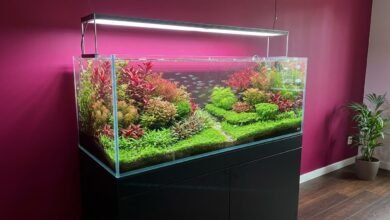
An iwagumi aquascape is a minimalist planted aquarium featuring a carefully arranged collection of stones, with a single low-growing plant species covering the bottom and the open water above.
The term “iwagumi” means “rock formation” in Japanese, and the aquascaping pioneer Takashi Amano promoted the style in the 1990s.
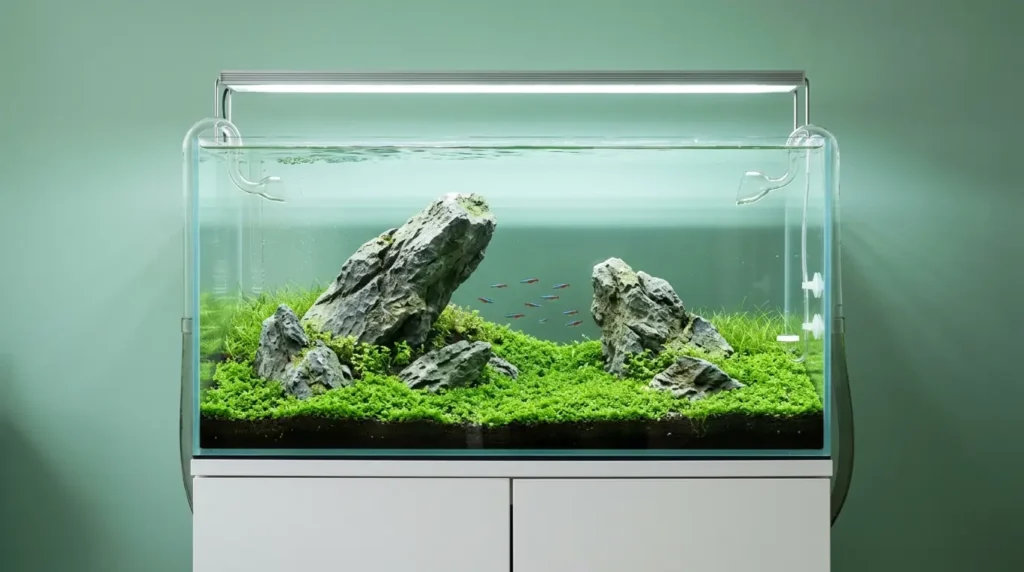
Conventionally, an odd number of stones of the same kind is used, one of which (the Oyaishi) forms the focal point of the arrangement and the other stones serve to support it in both size and position.
All other elements are kept simple on purpose: there is one carpeting plant, a small number of schooling fish, and a lot of space.
This emptiness is the key idea, and it is because of this that the iwagumi aquascape is one of the most difficult styles to execute well and also one of the most satisfying when it is successfully achieved.
Table of Contents
Why Negative Space Matters So Much
It is helpful beforehand to know why this style is effective since the empty spaces in an iwagumi are not spare spaces but rather form part of the design.
A study of the Ryoanji rock garden in Kyoto, a place which has influenced many Japanese minimalist arrangements, showed that the “empty” areas between the stones were implicitly structured and aligned with the temple’s architecture, something the authors say is a major reason for the garden’s attractive appearance.
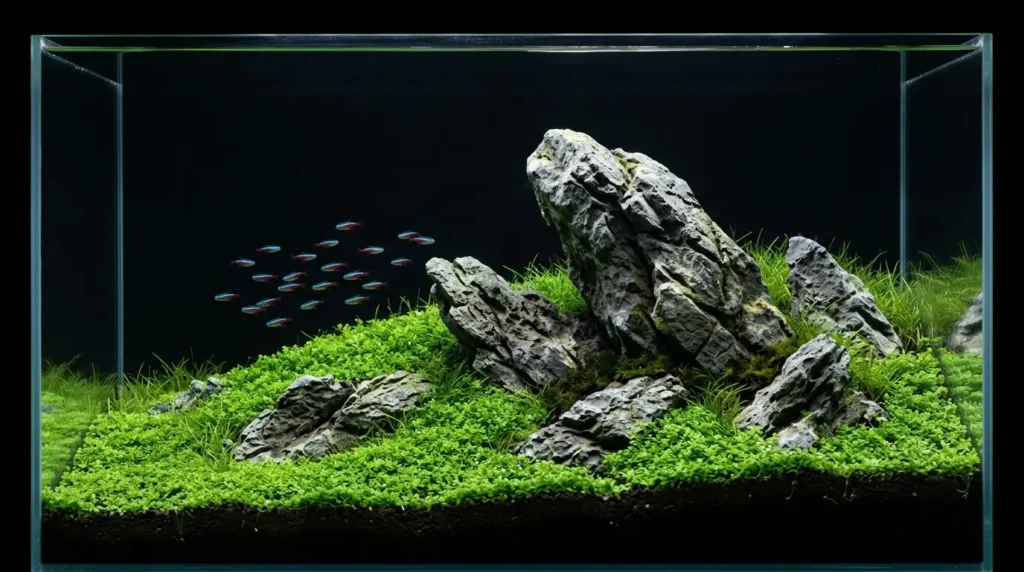
It’s unnecessary to carry out a shape analysis on your tank, but you should keep the idea in mind. Each stone you put down alters the shape of both the water and the carpet nearby.
Iwagumi Aquascape Core Layout Rules
You can easily distinguish a good iwagumi aquascape from a bad one at an early stage by how deliberate the placement of the stones appears. These are the rules that most aquascapers adhere to:
Choose a number of stones that is odd. The most common selections are three, five, or seven. Using an odd number prevents the arrangement from appearing stiff and symmetrical and helps to create a more natural-looking group.
For your initial iwagumi aquascape, three or five stones will be more than enough, so there’s no need to complicate it.
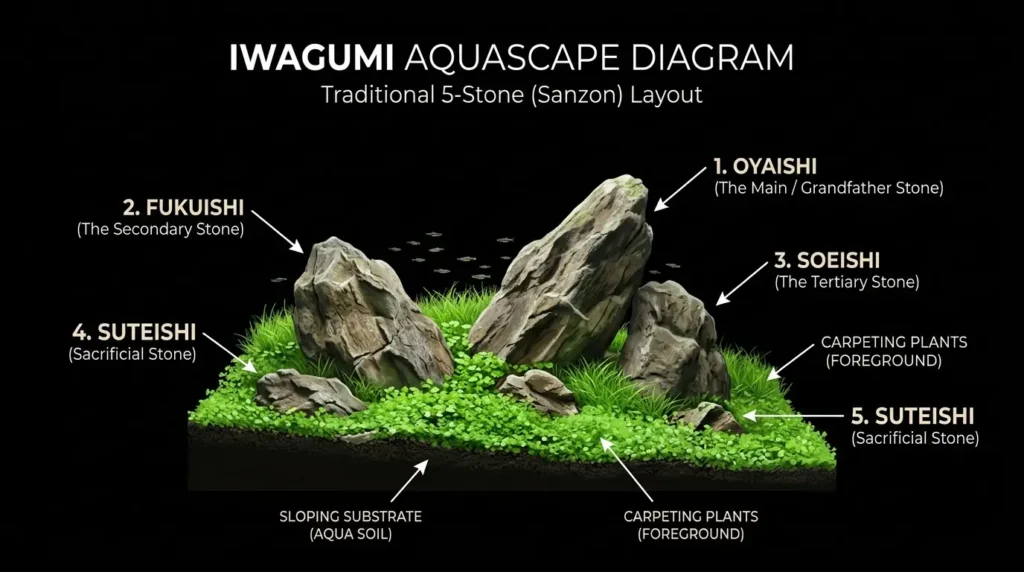
It’s important to understand the different types of stones. The Oyaishi is the principal stone and should be the largest and most prominent, typically positioned off-centre.
The Fukuishi acts as the secondary stone, being smaller than the Oyaishi and placed next to it to support it.
The Soeishi is the third stone, even smaller than the Fukuishi, and it provides a sense of balance.
Any additional stones are referred to as Suteishi, which are accent stones used to bring the composition together and break any obvious pattern.
Put the main feature off to one side. Since most arrangements adhere to the rule of thirds or the golden ratio, the Oyaishi is positioned approximately one-third of the way across the tank rather than in the centre. Main stones that are placed in the middle tend to appear static.
Try to arrange the stones in a triangular formation. The triangle should be irregular, with the highest point on one side decreasing in height as it slopes towards the other side.
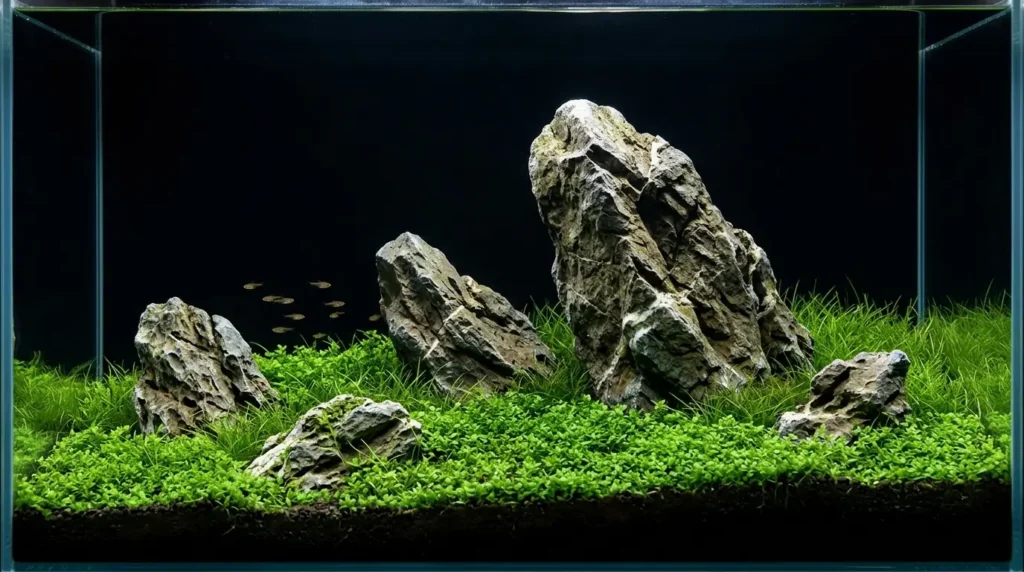
This arrangement gives the layout a sense of depth and movement even though only a small number of rocks are used.
Stick to a single kind of stone. Combining different types of rock makes the appearance look untidy. Choose one such as Seiryu, Dragon Stone, or Mountain Stone and stay with that one.
Ensure that the colour, texture, and grain direction are the same for all the stones so that they appear as though they have come from the same cliff.
Put the stones down so that about one third to half of each one is buried. A stone on the surface appears in the same way as a stone on the surface.
Burying them to that extent makes them seem to be part of the landscape and also helps to keep them stable, even though this may not sound very important, because if a stone falls it can crack glass.
Provide a lot of open water. Don’t feel the need to fill the middle of the tank; a smaller number of stones, placed well, together with a clean carpet will always be better than a crowded arrangement.
Equipment and Materials
Since the basic elements account for most of the expense in this type of construction, it’s important to get them right the first time.
A rimless, low-iron glass tank of about 60 cm is the traditional choice, and by using a wider and shallower shape (for example, a 60 x 30 x 36 cm one) you provide yourself with more space to create depth.
Although smaller tanks are easier on the budget, they are more difficult to balance. The usual choice is nutrient-rich aqua soil since carpet plants obtain a lot of their nutrients through their roots.
It adds a layer that slopes from the front to the back, being thinner in the front and thicker in the back, giving a sense of depth and making it easier to plant the front carpet.
Lighting
Carpeting plants require a strong and even light. Choose a lamp that has good output and a full spectrum of colour, and keep it on a timer since consistent light periods help to prevent algae.
With regard to CO2, most classic iwagumi carpets, for example Hemianthus callitrichoides “Cuba” or dwarf hairgrass, grow best when pressurized CO2 is used.
Although you can try a more basic approach with tougher plants, you can expect a slower rate of growth and a less dense carpet.
Filtration
A canister filter fitted with glass pipes for both inflow and outflow keeps the tank clean to see. The outflow should be directed so that it gently moves the water across the carpet without blowing the plants out of the substrate.
Plants
When it comes to plants, stick to one species of carpeting. Other popular choices are dwarf hairgrass and Glossostigma, and the amount of trimming you’ll need to do later will depend on your choice.
How to Set Up an Iwagumi Aquascape
First, plan this out on paper by drawing the layout, noting the position of each stone, and deciding which one will be your Oyaishi.
Add and shape the substrate
Pour the soil into the area and form a slope, making sure that the rear part is higher so that the main stones have something to rest on and so that the carpet at the front can easily be picked up with tweezers.
Put the stones in place
Begin with the Oyaishi, then add the Fukuishi, then place the Soeishi, and after placing each one, take a step back to check the balance.
Push each stone down into the soil until it appears to be planted rather than just placed. If a stone looks incorrect, move it at this stage since it will become more difficult to do so later.
Plant the carpet
Cut the carpeting plant into small pieces and press these pieces into the substrate using tweezers, making sure they are evenly spaced.
To prevent the plants from drying out, cover the soil with a fine mist of water at the time of planting, so it’s important to carry out the planting quickly.
After that, gradually fill the tank by pouring the water onto a plate or into a plastic bag so as not to disrupt the arrangement.
Cycle the tank before introducing fish
This step is by no means optional. Fish produce ammonia, and this substance is toxic to them, so you need a bacterial population in your filter that turns it first into nitrite and then into nitrate.
It should be noted that ammonia toxicity is primarily due to the unionised form and that its impact is greater at higher pH levels, something you should keep in mind if your tap water is alkaline.
Introduce livestock gradually
When the tank has been cycled, add a small group of fish that remain in the middle and upper layers of the water, for example, ember tetras or small rasboras, together with a few shrimp to assist with the algae.
Do not feel the need to include a wide variety of species, since the same principle of minimalism applies to the fish as it does to the plants.
Common Mistakes
Early attempts at forming an iwagumi aquascape usually come up against the same difficulties, so it is useful to be aware of them beforehand.
The most common mistake is to use too many stones. Newcomers tend to add extra ones in order to fill in empty-looking areas, but it is actually that space which gives the arrangement its effect.
The next issue is symmetry. If the left and right sides are mirror images of each other, the scene will appear artificial, so it’s best to place your point of focus off centre and to use stones of different sizes.
Another problem is inadequate stone burial, since stones that are left on the surface look as though they have been pasted down.
Algae are a frequent problem in the early weeks and are generally due to excessive light, insufficient CO2, or because the tank is not cycled.
Begin with a shorter photoperiod, gradually increase it, and once the carpet has become established carry out regular trimming so that the light can reach the lower leaves.
Patience is important. It can take the carpet weeks or even months to fill in and, during this time, the tank will appear sparse.
There’s a tendency to want to move the stones about or add some decoration to make the arrangement look ‘complete’, but the entire effect relies on restraint.
Also read:
- The Ultimate Aquascaping Toolkit for a Planted Tank
- Reef Tank Aquascape: How to Place Rock and Coral
- The Betta Aquascape: Layout Rules & How to Set Up
- The Dragon Stone Aquascape: Layout Rules & How to Set Up
- Seiryu Stone Aquascape: Important Facts and Maintenance
- Dutch Aquascape: Important Facts And Maintenance
- 5 Most Attractive 20 Gallon Long Aquascape Ideas

5 Comments