Reef Tank Aquascape: How to Place Rock and Coral
A reef tank aquascape is the planned arrangement of live rock, rockwork structures, sand, and corals in a saltwater aquarium so the tank looks like a natural coral reef while also providing a stable home for fish and invertebrates. A good reef tank aquascape does three jobs at once.
It gives corals solid, well-lit places to attach. It lets water move freely through and around the rock so that nutrients arrive and waste leaves, and it leaves open sand and swimming space so the whole display feels balanced. Think of it as the skeleton of your tank. Everything else you add later hangs off the decisions you make here.
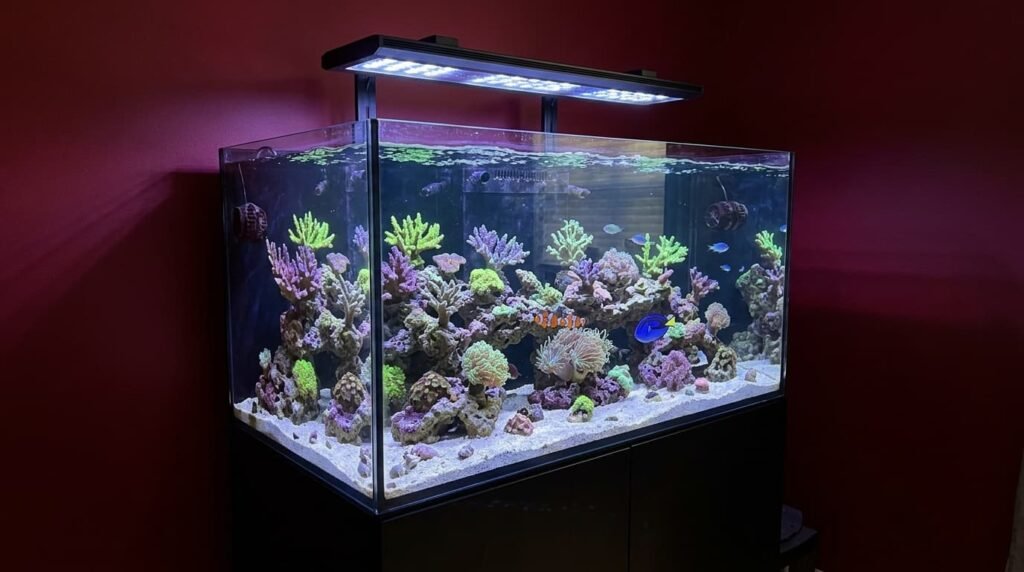
When you start reef aquascaping, the first thing to understand is that your rockscape is more than decoration. The shape of your live rock decides where coral placement is even possible, how strong the flow will be in each corner, and how easy the tank will be to clean for the next ten years.
Table of Contents
Pre-Planning
Always think about where you want the eye to go before you stack a single piece. Most reef aquascapes fall into a few broad styles. An island style puts one or two main rock structures in the middle of the tank with water on every side.
A wall style pushes the rock toward the back glass and leaves a big open front. A split style places two separate towers with a channel between them. None of these is the best option, so pick the one that fits your tank size, your livestock, and how much open sand you want.
A useful trick is to build the whole thing on a table or in an empty tank first. Lay out your rock, move it around, and step back to look at it from the front, the sides, and above.
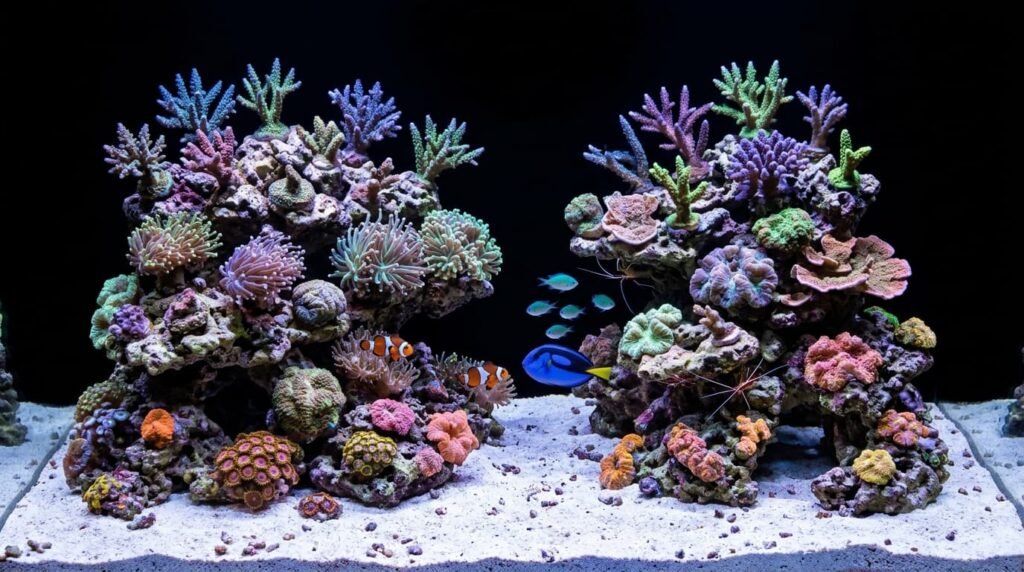
It costs you nothing at this stage, and it is a lot easier than fishing a heavy piece of rock out of a full tank later on. If you can, photograph a few versions and compare them side by side.
Keep in mind that the finished aquascape will be crowded by coral growth in a year or two. Plan for that now. A tank that looks a bit empty on day one is usually the one that looks best at the 18 month mark.
Rock Selection
Live rock, dry rock, and manufactured ceramic rock all work, and each has a trade-off. Dry rock is cheap and clean, but it needs time to seed with bacteria and life. Live rock arrives with a ready-made community, although it can carry hitchhikers you may not want.
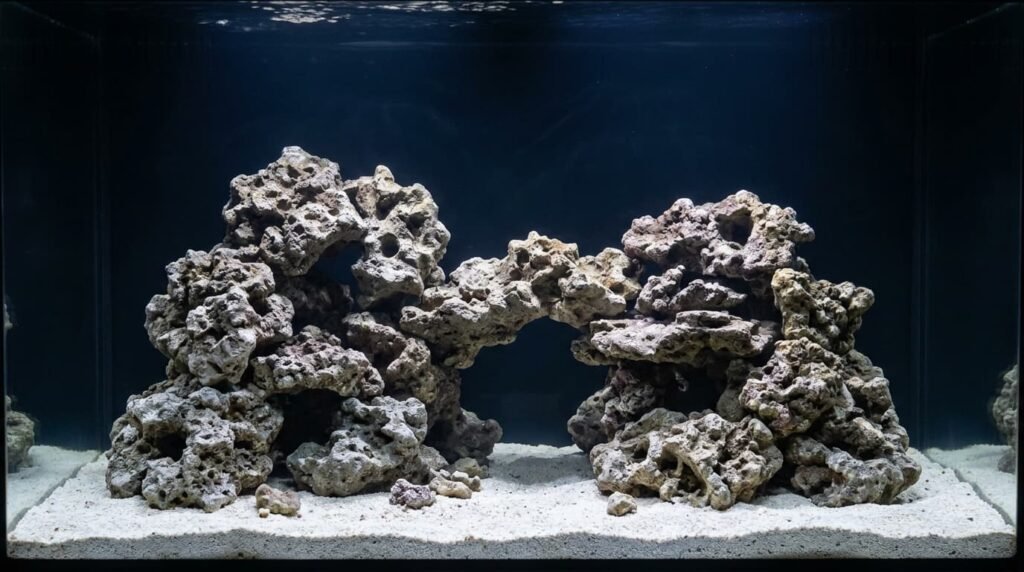
Ceramic rock is lightweight and often shaped for easy stacking. Whatever you choose, look for pieces with natural holes, arches, and flat surfaces, because those are the pieces that make interesting caves and give you plenty of places to attach coral frags.
Buy a mix of sizes. A few large base pieces, several medium connectors, and a handful of small accent rocks give you much more freedom than a pile of identical chunks. Larger pieces do the heavy lifting at the bottom, while the smaller ones fine-tune the shape at the top.
Build a Foundation
This is the part people rush, and it is the part that causes the most disasters. Build your rockwork on the bottom glass or a solid base, never on top of loose sand, because burrowing animals can undermine a tower and bring it down.
Stack from heavy to light, use marine epoxy or reef-safe putty at the contact points, and add rods or pins through the thicker pieces if you are going tall. Give each joint a gentle shove before you call it finished.
Try to keep rock off the glass walls where you can. A gap of a few centimeters lets you reach in with a scraper and a siphon, and it stops detritus from piling up in dead spots. Leave a couple of larger arches and tunnels too, so that you can get a hand or a tool through the structure when you need to.
Also remember that waste can settle in every cave and overhang. Build with cleaning in mind, and you will thank yourself later.
Reef Tank Aquascape Water Flow
Water movement is one of the most important things to think about when you plan a reef tank aquascape, because rock that blocks flow creates dead zones. Research on coral physiology shows that water motion transports nutrients to corals, flushes away waste products, increases particle capture, and helps remove excess oxygen produced during photosynthesis. In other words, your rockwork should be a set of channels, not a wall.
The numbers matter too, although not as much as people think. In a 42-week experiment with the stony coral Galaxea fascicularis, corals kept in still water grew significantly slower; growth was not significantly different between 10 and 20 cm per second, and it was higher again at 25 cm per second. A more recent study also found that optimal flow differs among coral species and even among individual colonies, which means you should treat any flow target as a starting point and then watch how your own corals respond.
So leave open lanes between your rock structures, aim your pumps so the water sweeps through the gaps, and check the back and bottom of the reef tank aquascape for places where debris collects. If you see detritus settling somewhere, that is a sign that you need more flow or a different rock layout in that spot.
Light and Zones
A reef is not one uniform habitat, and your tank does not need to be either. The top of your rockscape will receive the most light, the middle will get a bit less, and the lower caves and overhangs will be shaded.
Use that to your advantage. High-light corals such as many Acropora go near the top; softer and low-light species like some mushrooms and certain LPS corals fit lower down, and shaded spots can hold sponges and other non-photosynthetic life.
Light and flow also work together. Dutch research on Galaxea fascicularis explored how light and water flow jointly influence coral growth and physiology, so it is worth positioning a coral with both factors in mind rather than treating them separately. A coral in a strong-light, weak-flow corner might not behave the same as one in the same light with better flow.
Coral Placement
Once the rock is stable and the tank is cycled, it is time for coral placement. Take it slowly. Add a few pieces at a time and place each one where it will have space to grow in every direction.
Do not place a fast-growing branching coral right next to a slow-growing, low-profile one and hope for the best.
There is solid science behind this advice. Corals compete for space, and some species damage neighbors through sweeper tentacles or digestion with their mesenterial filaments. Sweeper tentacles are not always present either.
Classic work on the Caribbean coral Agaricia agaricites showed that elongated sweeper tentacles develop in response to direct competition, which means a coral that looks harmless today can arm itself once a neighbor gets too close.
Researchers have also linked aggressive ability to stinging cell types, and have ranked corals on an established hierarchy from aggressive to subordinate.
The practical takeaway is simple. Leave a gap of several centimeters between different species, keep known aggressive corals on their own rock, and put the gentler ones together. Watch the borders between colonies every week or two, and if you see pale tissue or exposed skeleton where two corals meet, move one of them.
Also, try not to glue every coral to the very top of the structure. Leave some prime spots open for frags you want to add later, and keep a few flat plugs on hand so that you can shuffle things around as colonies grow.
Sand, Fish, and Maintenance
Open sand is part of the design, not wasted space. Fish need swimming lanes, sand sifters need somewhere to forage, and you need space to siphon.
As a rule of thumb, keep at least a third of the footprint of the tank free of rock, and avoid filling the whole tank right up to the waterline unless you are intentionally building a tall tower.
When the reef tank aquascape is done, fill the tank slowly with a plate or bag over the sand so you do not blast your rock out of position. Then run the tank for a while before adding fish, and check each joint again once the water is in. Rock tends to shift a little as it settles, and it is far better to catch that early.
Finally, so the scape does not get stale, plan to prune. Corals grow, algae creeps in, and a rockwork that looked perfect in the first month will look different in the sixth.
Trimming and rearranging every few months keeps flow lanes open and keeps your reef tank aquascape looking the way you intended.
Also read:
- The Ultimate Aquascaping Toolkit for a Planted Tank
- The Betta Aquascape: Layout Rules & How to Set Up
- The Dragon Stone Aquascape: Layout Rules & How to Set Up
- The Iwagumi Aquascape: Layout Rules & How to Set Up
- Seiryu Stone Aquascape: Important Facts and Maintenance
- Dutch Aquascape: Important Facts And Maintenance
- 5 Most Attractive 20 Gallon Long Aquascape Ideas


5 Comments