The Betta Aquascape: Layout Rules & How to Set Up
A betta aquascape is a planned aquarium layout built around Betta splendens (Siamese fighting fish). Done well, it gives your betta places to rest, explore, and hide while keeping water quality stable and the setup visually appealing.
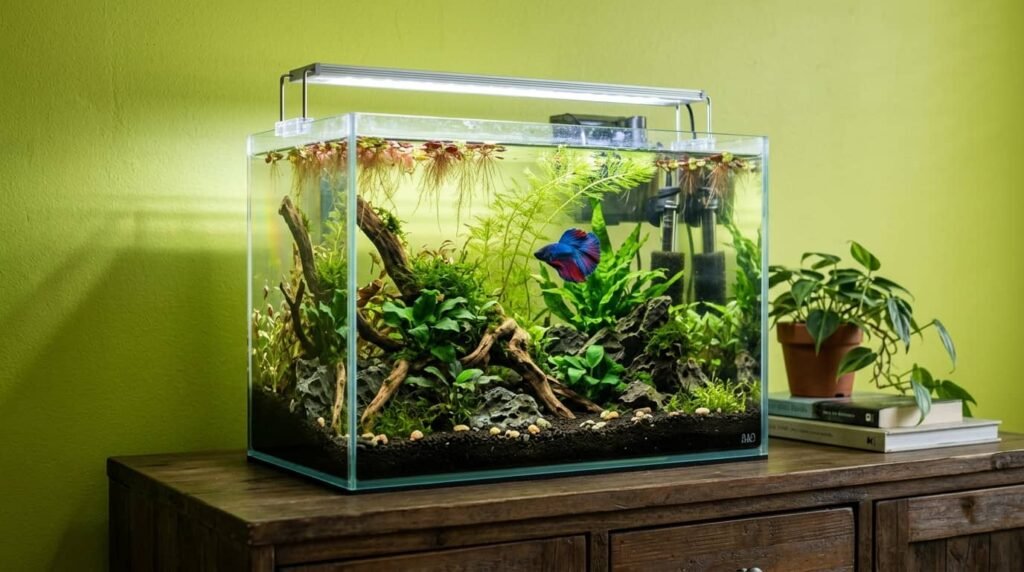
It uses live plants, hardscape (driftwood and smooth rocks), substrate, and open swimming space. Unlike a generic planted tank, a proper betta aquascape accounts for the fish’s long fins, its habit of breathing air at the surface, its territorial nature, and its need for both cover and room to cruise.
Table of Contents
Layout Importance
Before you place the rocks, remember the arrangement serves a purpose beyond decoration.
Male Bettas kept in small 0.5 L bowls spent less time swimming than those kept in larger 10 L, 38 L, and 208 L aquaria, and the fish in the enriched containers swam more frequently. Researchers found that a 10 L aquarium is necessary for full swimming behaviour.
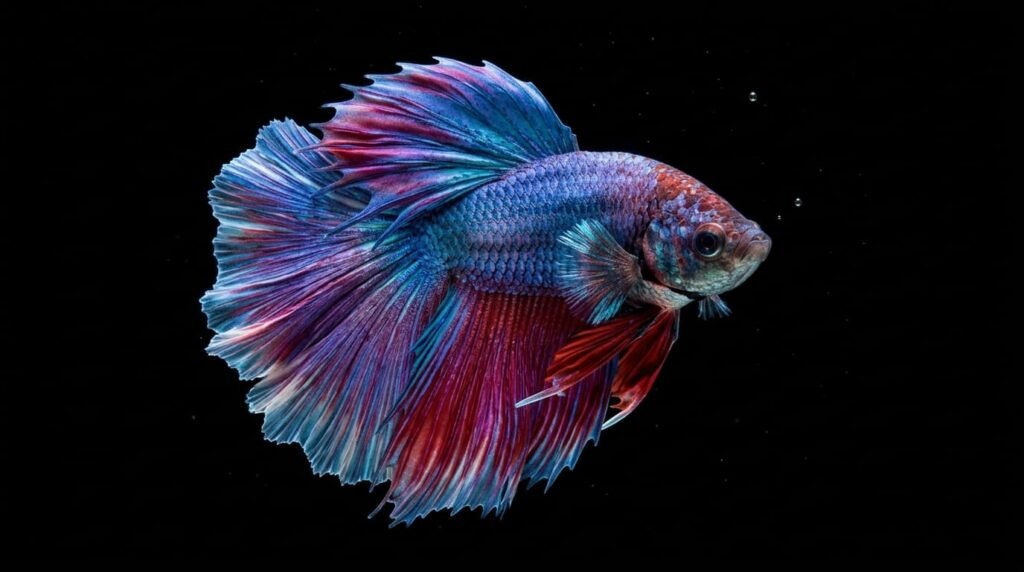
The furnishings also play a role. Every tank should include gravel, live plants, and areas where the fish can take refuge. Moreover, bettas kept in small tanks were seen to spend more time hovering.
This is a behaviour the researchers considered possibly abnormal since it is not associated with nest building. To put it simply, choosing a tank with nothing in it is not a neutral option. It does affect the way your fish behaves.
The Core Layout Rules
Very early in the planning process, you can generally judge whether or not a design is going to work or whether your betta is going to end up spending its whole life staring at a blank wall.
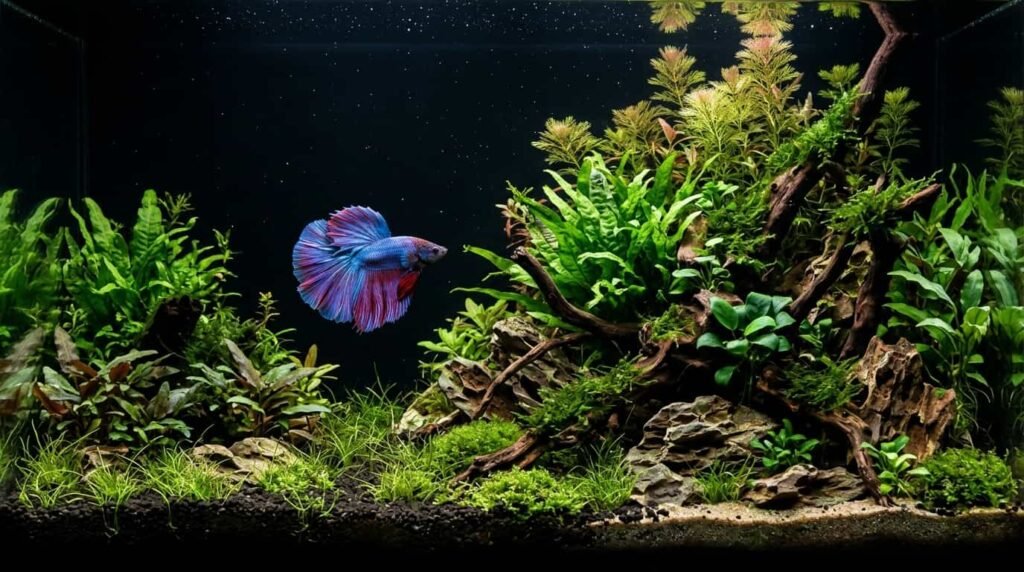
If you follow these rules, you’ll be able to avoid the majority of the usual mistakes.
Rule 1
Leave the top third of the tank open. Since bettas have a labyrinth organ that enables them to take in air from the surface, it’s important that they have easy access to it.
Floating plants are useful, but gaps should be left between them. If a thick mat of leaves covers the entire surface, the fish will have to struggle its way up each time it wants to breathe.
Rule 2
When planting, place the plants along the back and sides, not in the middle. You should use tall, bushy stems on the rear and along the sides, leaving a clear path down the centre.
This creates a natural corridor for the fish to swim in and makes the tank simpler to clean and to take photographs of. It also allows your betta to display its fins without them getting caught.
Rule 3
Include at least two places where the fish can retreat. Place one cave, a hiding spot, or a dense cluster of plants on each side of the tank.
If a fish has only one place to hide, it may end up stuck looking after it, whereas a fish with two can choose its preferred spot according to its mood.
Nevertheless, don’t feel the need to fill up every corner. Keep about 30 to 40 per cent of the area’s surface area covered with hardscape and plants and leave the rest uncovered.
Rule 4
Apply the rule of thirds by positioning your main subject (for example, a large piece of driftwood) one third of the way in from one side instead of placing it in the exact centre.
Symmetrical compositions appear stiff, while an asymmetric one gives the effect of a natural scene.
Rule 5
Make sure everything is soft and smooth since long fins are likely to tear. Before putting anything into the tank, run a pair of pantyhose or a cotton ball over all the surfaces.
If it catches, sand the surface down or exclude it. This applies even more to artificial plants, so if you choose to go down that route, select silk rather than hard plastic.
Choosing Plants Your Betta Will Actually Use
Live plants absorb nitrogen waste and produce the visual interruptions that make the tank seem like a territory.
A study from Brazil found that bettas preferred environments that included shelters and natural plants, and the most frequently visited species were Egeria (elodea) and Salvinia.
For a beginner-friendly plant list, these are hard to beat:
- Anubias and Java fern: Tie or glue them to wood or rock instead of burying them. They’re tough and slow-growing, and the broad leaves double as resting platforms.
- Java moss or Christmas moss: Great for softening hardscape edges and covering bare patches.
- Floating plants (Salvinia, frogbit, water sprite): They diffuse light, and bettas often like resting beneath them. Just thin them out regularly.
- Cryptocoryne and dwarf sagittaria: Good midground carpets that stay low and out of the swimming lane.
How to Set Up a Betta Aquascape
- Pick the tank. Make sure it has a capacity of at least 10 litres (approximately 2.5 US gallons), and 20 litres or more if you want a setup with actual depth.
- Add the substrate. Use either fine gravel or sand and shape it so that it is slightly higher at the back. Make sure the layer is thin enough so that it can be rinsed and leveled easily.
- Place the hardscape first. Set driftwood and smooth stones before adding water. Move the elements around until the area you want to highlight is in the desired position, then check for any sharp edges.
- Plant in order. Start with the background stems, followed by the midground ones, and then attach the epiphytes (such as Anubias, Java fern, and moss) to the hardscape. Finally, add the floating plants.
- Fill the tank slowly. Pour the water onto a plate or into a bag so as not to scatter the substrate, and dechlorinate the water.
- Install a gentle filter. Bettas dislike strong currents. A sponge filter or a baffled filter outlet is suitable, and you can make the current even slower by directing the flow towards the glass.
- Heat and cycle. The water should be kept at a constant tropical temperature (usually between 24 and 27°C, or about 76 to 80°F), and the tank should be cycled before the fish are introduced. Cycling involves allowing the beneficial bacteria to develop so that the ammonia and nitrite will not poison your betta.
- Introduce the betta. Float the bag, acclimate slowly, and keep the lights low on the first day.
What Decor Can’t Do
A well-designed layout is useful, but it won’t cause a territorial male Betta to become a roommate. A study into aggression showed that environmental enrichment on its own had no significant effect on the aggressive behaviour of Bettas.
Therefore, do not count on a nicely arranged tank to keep two males safe together. You should keep males individually, and if you want to keep them with other fish, then you must carry out careful research and have a spare tank ready.
Maintenance Tips
When your betta aquascape is up and running, the key is to develop small and consistent habits. Cut back the floating plants on a weekly basis so that the surface remains open, and trim the stems before they become too dense and block the swimming area.
Carry out a partial water change about once a week and remove the debris that collects in the areas around the hardscape.
If algae appears on your driftwood or rocks, don’t worry because a small amount is normal in a newly set up tank, and reducing the daylight to about 6 to 8 hours a day generally gets it under control.
Whenever your betta ignores the cave that you have spent an hour arranging and instead settles down on a leaf, this is a signal for you to put more leaves in that area.
Also read:
- The Ultimate Aquascaping Toolkit for a Planted Tank
- Reef Tank Aquascape: How to Place Rock and Coral
- The Dragon Stone Aquascape: Layout Rules & How to Set Up
- The Iwagumi Aquascape: Layout Rules & How to Set Up
- Seiryu Stone Aquascape: Important Facts and Maintenance
- Dutch Aquascape: Important Facts And Maintenance
- 5 Most Attractive 20 Gallon Long Aquascape Ideas


6 Comments