Permaculture Raised Beds: Tips for Beginners
Permaculture raised beds aren’t simply wooden boxes filled with soil. You’re deliberately creating a small ecosystem that feeds itself, retains water, and requires less effort each year.
Early on, you can determine whether a bed will look after itself or become a weekend task, and the following tips focus on the most important choices for people just getting started.
Also read: List Of All Useful Permaculture Tools
Table of Contents
Where To Build Permaculture Raised Beds
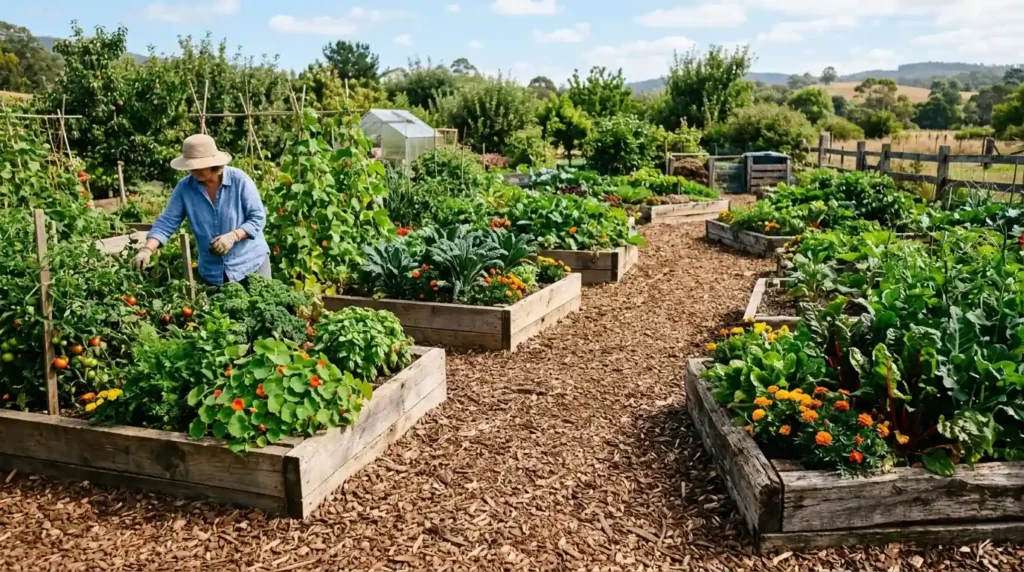
When deciding where and why to place a bed, consider the amount of sunlight it will receive, the proximity of a water tap, and make sure there is enough space to walk around it.
These factors will be more beneficial to your harvest than any sophisticated soil mixture. Do not make the permaculture raised beds wider than 3 or 4 feet, since then you’d have to step on the soil to get to the middle. Standing on the soil will compact the very soil you have worked to loosen.
Also read: Things to Consider When Making a Permaculture Pond
You should also take care when planting on hard surfaces. A shallow bed situated on tiled ground will suffer from serious drainage issues.
For the complete exchange from the original r/gardening thread, see the source. The key point is that it is depth and drainage that determine whether a bed on a hard surface will survive or not.
Fill It Like You Mean It
A great many people who are just getting started think that regular garden soil is sufficient. However, it is usually too compact, and the roots find it difficult to get through.
A standard mixture consists of one-third compost, one-third topsoil, and one-third a material that loosens the soil, such as coconut coir.
Since raised beds take up a large amount of soil, it is important to work out the cost of the soil before you start building them.
If you live in an older part of a neighborhood, then you should test the soil before planting any food. Remember that even a clean bed in a dirty yard can gradually pick up dust and splashes from the soil surrounding it.
Choose Your Building Materials Wisely
Do not use any pressure-treated lumber that is older. Studies involving Boston community gardens found that arsenic can seep into the soil of a garden from lumber that has been treated with chromated copper arsenate.
Instead, it is safer to use untreated cedar, stone, or concrete blocks, and you can always put a liner inside a doubtful frame.
Handle Hügelkultur With Care
It is a standard practice in permaculture to bury logs and branches at the bottom of a bed since this helps to save soil, and the decaying wood retains water just as a sponge would.
The problem, however, is nitrogen. A study published in the Canadian Journal of Soil Science showed that when wood was buried, it increased the carbon-to-nitrogen ratio of the soil and could lead to nitrogen immobilization if the wood made up 10% of the volume or more.
Although it should be noted that this was a laboratory experiment carried out on soils used for reclamation and not in a backyard bed, the underlying mechanism is the same.
Wherever possible, use old, partly decayed wood since fresh wood draws nitrogen most strongly. Lay over the wood a good amount of compost and plant beans or peas in the first year to help even things out.
You should also be careful about the types of plants you choose; gardeners on permaculture forums advise against burying willow if you don’t want willow growing in your beds.
Mulch Early and Often
Leaving the soil bare is a wasted chance. Organic mulches help to retain soil moisture, reduce soil temperature, and suppress weeds. When you plant, spread it out about 1 to 2 inches thick over the bed.
It isn’t true that all types of mulch perform in the same way. A field trial carried out in Lithuania on beets and onions showed that grass mulch provided the largest increase in yield, whereas buckwheat husk mulch reduced yields in subsequent seasons.
When it appears that a new mulch is not working as expected, it’s a good idea to test it out on one corner of the bed before applying it to the entire bed.
When buying new beds, place some cardboard at the bottom to prevent the growth of grass and weeds; use ordinary brown cardboard and make sure that you remove the tape first.
Plant in Mixes, Not Rows
Plants grow most effectively when they share a bed, which is why you should grow fast-growing crops such as radishes among more slowly growing ones like peppers or tomatoes. \
Also read: 25 Easy-to-Care-for Plants for Permaculture
This isn’t just common wisdom; a global meta-analysis published in Nature Plants showed that intercropping saved 16 to 29% of land and 19 to 36% of fertilizer when compared to growing the same crops separately.
Since most of the research was carried out in farm fields, consider the figures as indicating a general trend rather than as a guarantee for your 4×8 bed.
Start Small and Adjust
In the first year, build one or two permaculture raised beds, make some notes, and then expand your garden once you understand how the sun moves over your yard. After that, continue to feed the soil with compost and mulch rather than replacing the soil.
And finally, since the pathways should also be considered, give them some thought. Using wood chips between the permaculture raised beds keeps your feet dry and puts the weeds under control, as well as breaking down to form more soil over time.

3 Comments