The Science Behind Beekeeping Swarm Trap
A beekeeping swarm trap is the cheapest method of getting an additional bee colony into your garden. All you have to do is wait for the scout bees to appear.
However, before you begin, note that a swarm trap does not guarantee success; it works because you know what bees want in a hive, so it’s important to understand that beforehand.
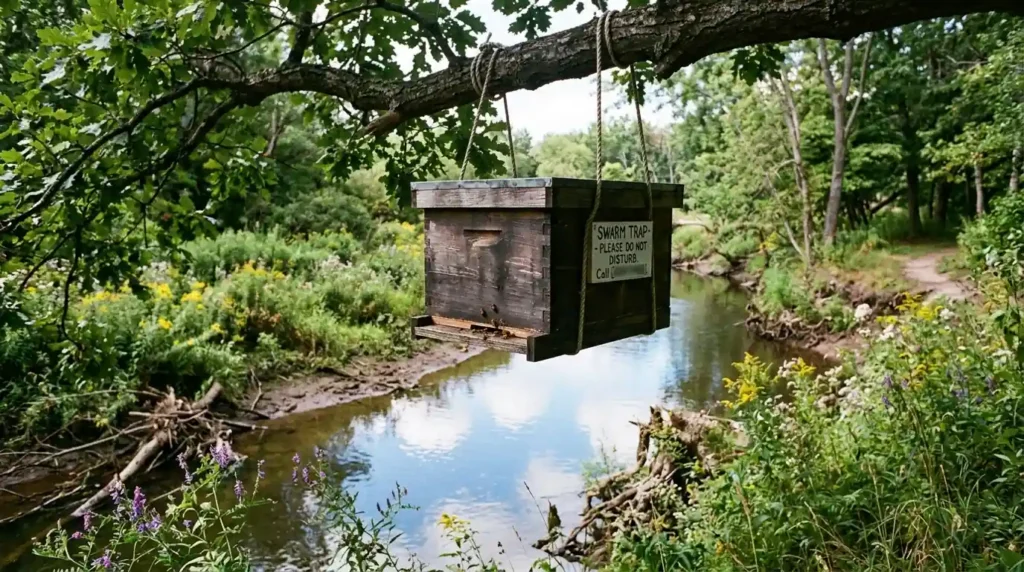
Table of Contents
What a Beekeeping Swarm Trap Actually Is
A beekeeping swarm trap, or bait hive, is simply an empty box that appears to be a suitable place to live. It is placed in a tree or on a stand in an area where swarms are likely to pass by.
The scout bees from a swarm that is leaving will examine it, and if it proves to be better than the other available options in the area, the entire swarm will move into it.
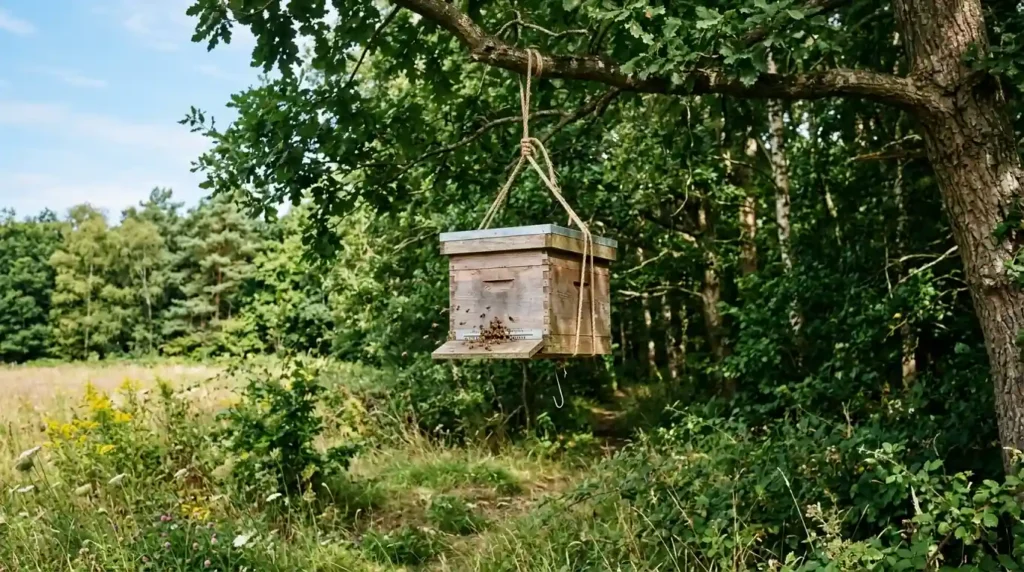
A nuc box, a cardboard nuc, or a stack of deep hive bodies will do. The box doesn’t have to be elaborate.
What is important is that it is the correct size, the right shape, and in the proper position, and these three factors are more important than any lure you can purchase.
Why Bees Move Into Your Box
A swarm never chooses a home by chance. Instead, it spends about 20 daylight hours looking around for a new nest site, and it has been shown that the scouts communicate the sites they have found and promote them using the waggle dance, and the swarm then settles on the most suitable one.
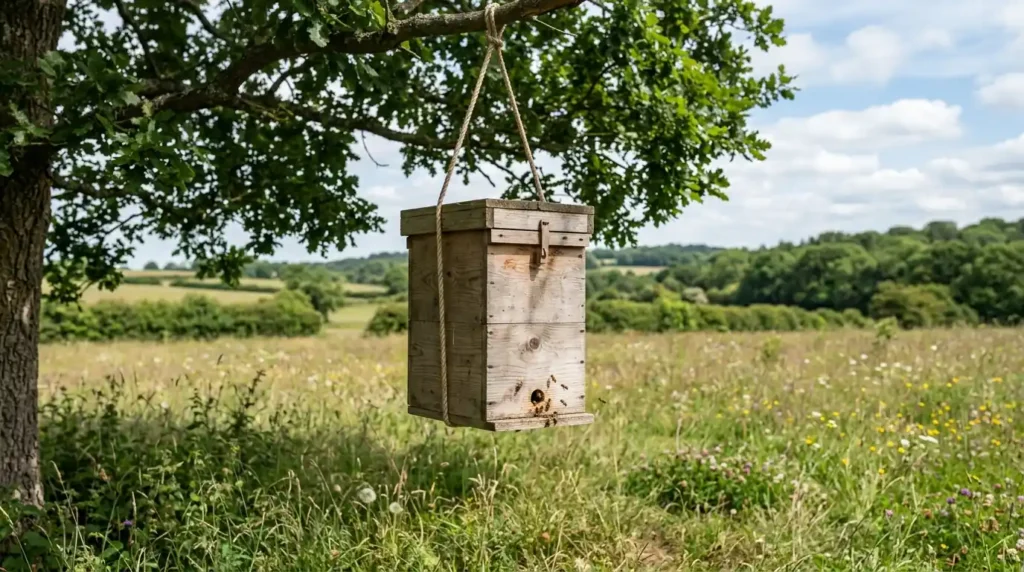
That means that your beekeeping swarm trap is up against every hollow tree, every wall cavity, and every dusty shed in the neighbourhood. If your box is only average, it will be beaten, so you should make it as attractive as possible.
Pick the Right Size Box
It is in the matter of size that most novice beekeepers make a mistake. Research into traditional nest sites showed that bees preferred a cavity with a volume of about 40 litres rather than one that was smaller or larger.
The scout bees actually calculate the volume by walking around the inside of the cavity. A single scout can take up to 40 minutes to carry out an inspection.
In one experiment, European swarms chose a 31-liter cavity over a 13.5-liter one in 84 percent of the choices they were offered.
A USDA study also found that swarm traps readily attracted swarms when cavities were in the intermediate range of about 20 to 50 liters.
Since a single deep Langstroth box is near that optimal size, it is an excellent starting point.
Just a quick warning: the same Schmidt and Hurley study showed that smaller 13.5-litre cavities are most suitable for trapping Africanized swarms, as most European swarms tend to reject them.
If you are living in an area where Africanized bees are present, you should carefully consider which box to choose and what you are prepared to deal with.
Get the Entrance Right
Bees are particular regarding the position of their main entrance.
The Seeley and Morse study showed that the bees preferred a small opening of approximately 12.5 square centimetres, an opening at the bottom of the cavity rather than one at the top, and an opening which faced south rather than one which faced north.
When setting up your beekeeping swarm trap, you should therefore reduce a wide-open entrance by using a block or an entrance reducer and orient the entrance to the south if you can.
Recent research also indicates that colonies prefer to start building comb near the entrance rather than near the ceiling.
You can think of it as giving the bees a shorter distance to travel. Therefore, if you have any, it’s a good idea to place a few frames with old drawn comb by the opening.
Where to Hang The Beekeeping Swarm Trap
Height is important. In the experiments carried out by Seeley and Morse, the bees preferred a nest height of 5 metres to 1 metre, which means that a greater height is usually better.
That said, you should be practical about how high you can safely go. If you’re comfortable using a ladder, a box placed 3 to 4 metres up, attached to a strong branch or secured to a post, should be a reasonable aim.
You must never climb alone and should never position a beekeeping swarm trap where a fall could be dangerous just so as to gain an extra metre of height.
A few other things help:
- Select a location that has some shade so that the box doesn’t get too hot in the afternoon sun.
- Choose a spot that is easy to see from the air, for example, the edge of a treeline or close to a landmark.
- Place the trap close to an apiary or a feral colony that is known to exist, as swarms usually originate from nearby areas.
- Ensure that you are able to return to the box whenever it’s time to collect it.
Don’t Rely on The Lure
A small amount of scent can decide the outcome. Beekeepers often place a few drops of lemongrass essential oil at the entrance since the main component of this oil, citral, is also present in the Nasonov pheromone that bees use to call one another home.
Furthermore, old, dark comb together with a thin layer of propolis also helps, as a box that smells like a hive seems safer to a scout.
It should be noted that the lure is the final touch. A box that is well-sized and in a good location with no scent will generally outperform a poorly constructed box even if it has the best lure available.
Timing
In most temperate areas, the swarm season lasts from spring until early summer, so set up your traps about a few weeks before you anticipate the first swarms.
Check the traps once a week or so. Keep an eye out for bees hovering near the entrance and moving in and out. If the entrance is busy but not crowded, then it’s likely that the scouts are examining the box and a swarm may soon follow.
Do not leave a trap empty for the whole season without checking it, since ants, wax moths, and wasps enjoy an unattended box.
Moving The Swarm Home
When the swarm has entered, wait until after dusk. By that time, the foragers will have returned to the hive. Close the entrance, secure the box by strapping it shut, and then carry it carefully to your apiary.
After that, open the entrance and allow the bees to settle down. In the case of a standard hive body, you can place the trap exactly where you want the new colony to be.
When you capture a swarm, treat it in the same way as a new colony whose origin is unknown. Carry out an early check for disease and mites, and provide food if the weather takes a turn for the worse before they have accumulated their stores.
You should also check the local regulations concerning the movement of bees, as in some areas there are rules about having to register or have colonies inspected.
Common Beginner Mistakes
The main reasons why traps fail are a few specific ones: the box was either too small or too large, the entrance was too wide, the trap was situated too low down, or no one checked it for weeks.
If you deal with these problems, your chances will improve considerably. Since swarm trapping requires a good deal of patience, it’s possible for some traps to remain empty throughout the whole season.
If you can, use more than one trap, and don’t get discouraged if the first few are silent.
Also read:




3 Comments