Forage Radishes: All You Need to Know
Forage radishes (Raphanus sativus), also sold as oilseed radish, fodder radish, daikon radish, and Tillage Radish®, are a fast-growing fall cover crop in the mustard family. They develop a thick taproot that can reach about six feet deep. The root breaks up compacted soil, pulls leftover nitrogen from deep in the profile, and crowds out weeds.
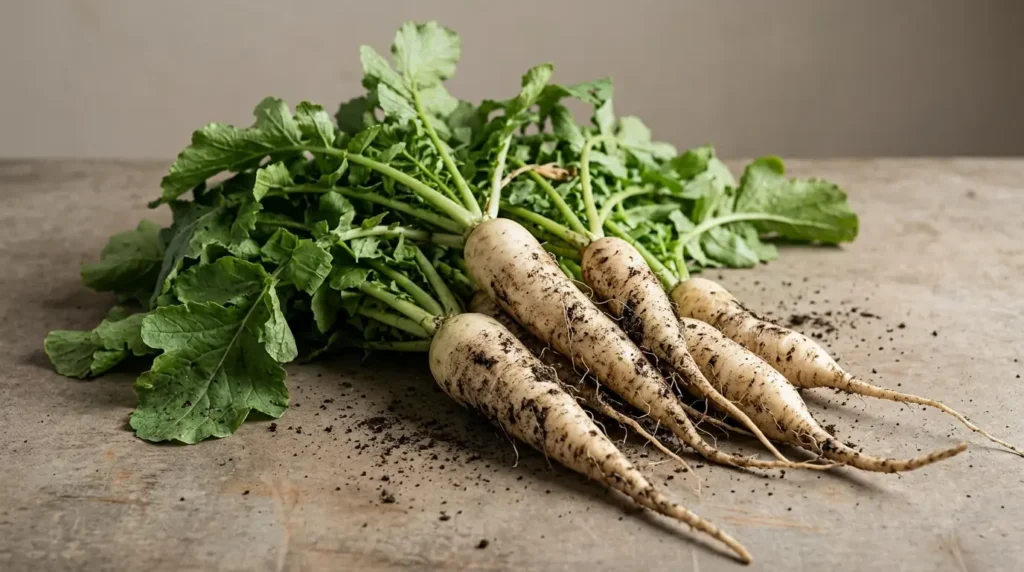
The tops also work as high-quality grazing. In most cold climates, the plant dies when temperatures drop below roughly 20°F, so it clears itself out of the field before spring planting.
Table of Contents
What Are Forage Radishes?
Forage radishes are not the salad radishes in your fridge. They belong to the same species, but they were selected for a very different job.
The thick white taproot can reach 1 to 2 inches in diameter, and the upper 12 to 20 inches of it swell as the plant matures. The leaves form a rosette that can stand two to three feet tall.
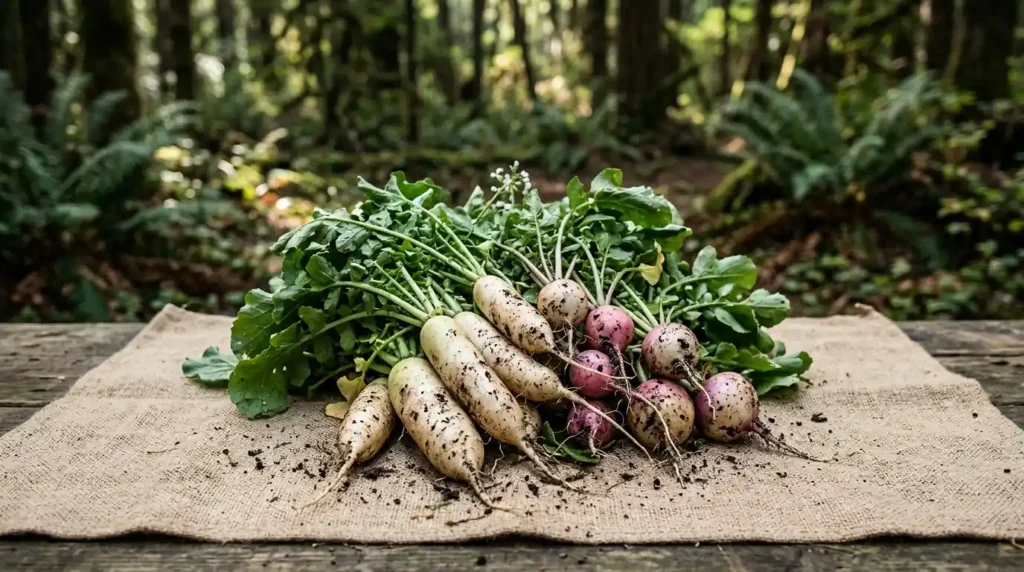
The naming is messy. Some literature separates forage radish from oilseed radish, describing oilseed types as having a stubbier, more branched root and better winter hardiness.
But radish varieties hybridize easily, and management advice is generally the same for both. Daikon, the Japanese food radish, is the same species too. Its leaves are edible and are sometimes eaten like mustard greens.
How Forage Radishes Break Up Compacted Soil
This is the big one. Soil compaction is a quiet yield thief. Extension specialists in West Virginia note that compaction can easily cut crop yields by 10 percent and increase runoff.
Forage radishes attack it from below. The taproot pushes through compacted layers better than cereal rye does. After it decomposes in spring, it leaves deep holes that let water and air in.
Cash crop roots move down when the soil is dry and hard. Planting radishes can work as a no-till alternative to deep tillage or mechanical ripping.
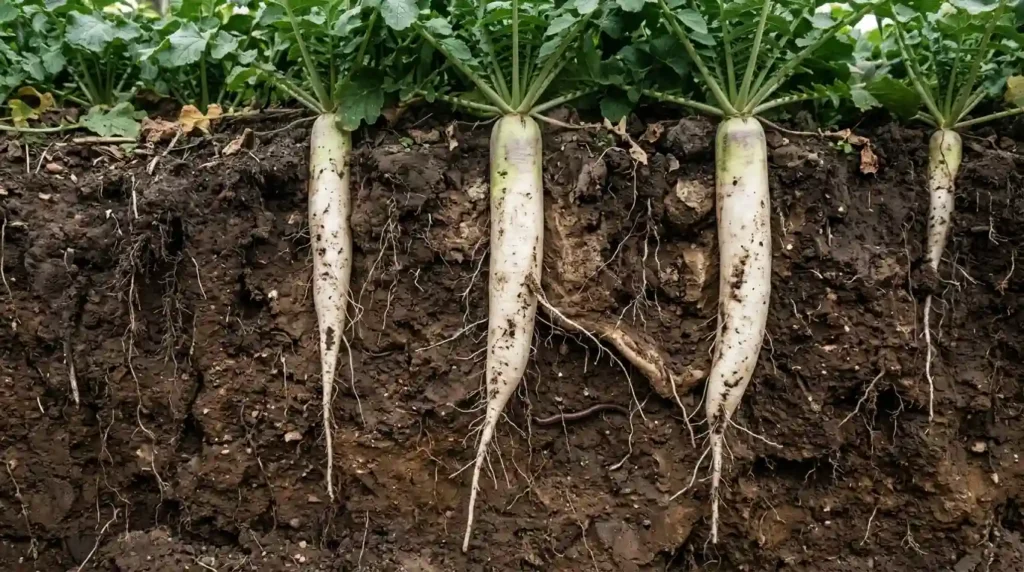
University of Maryland researchers tested this directly. Their trials at four Maryland and Pennsylvania sites with compacted layers 25 to 45 cm deep observed soybean roots growing inside channels left by cover crop roots.
The published results (Williams and Weil, 2004) reported that soybean roots used these root channels to get through a compacted plow pan.
Nitrogen Scavenging: Where Forage Radishes Shine
Nitrate that leaches below the root zone is money lost and a water quality problem. Forage radishes grab it before it escapes.
Forage and oilseed radish cover crops can absorb 100 to 150 pounds of nitrogen per acre. Their roots reach nitrogen at depths other cover crops cannot, and the plant releases that nitrogen when it decomposes in spring.
One Canadian trial found that fields planted to oilseed radish had lower nitrate in soil water than fields of red clover, ryegrass, or fallow.
There is a catch. The nitrogen comes back fast in spring, sometimes before your crop can use it. The USDA advises mixing radishes with a species that survives frost, such as rye, so the nitrogen is held rather than leached.
Weed and Pest Suppression
Radishes grow quickly. Seedlings can emerge in as little as 3 days and form a full canopy in 3 to 4 weeks. A Michigan study found that oilseed radish reduced weed biomass by 4,000 pounds per acre compared with fallow ground.
The mustard family also carries a chemical defense. Roots release glucosinolates, which can discourage soil-borne pests. Oilseed radish roots have been shown to trap sugarbeet cyst nematodes and block their reproduction.
Do not treat this as a cure, though. The USDA says pest control with this crop is still under investigation and works only as part of an integrated pest management plan.
Forage Radishes for Grazing
Yes, you can graze them. Oilseed radish can produce up to 2 tons per acre of highly digestible aboveground biomass, suitable for early and late season grazing by all classes of livestock.
Michigan State University lists dry matter at 1,500 to 4,000 pounds per acre.
Watch the bloat risk. Mix radishes with a grass species or supplement with hay to reduce bloat and other health problems in cattle.
When and How to Plant Forage Radishes
Timing matters more than anything else.
Planting window. Plan for at least 60 days of growth before winterkill; in the Mid-Atlantic, that usually means late August or early September. Count back from your first expected hard freeze.
Seeding rate. The rate depends on your goal. A pure stand is typically 6 to 10 pounds of pure live seed (PLS) per acre. Lower rates of 5 to 6 pounds produce bigger taproots for compaction. Higher rates of 15 to 20 pounds produce smaller roots with more root surface for pest suppression.
Method. Drill seed ¼ to ½ inch deep for the best stands. Broadcasting works at 12 to 14 pounds PLS per acre, followed by light disking or rolling. For aerial seeding into standing corn or soybeans, raise the rate to 14 to 16 pounds when the lower leaves start to yellow. One pound holds around 34,000 seeds.
Soil. Forage radishes like cool, moist conditions and a pH of 6.0 to 7.5. They do poorly in shade, standing water, and severely nitrogen-deficient soil.
Termination: Winterkill and Beyond
Cold does the work. Plants die when temperatures fall below about 20°F and then decompose in the soil. Michigan State notes that a mild winter, or good snow cover before the radish dies, can let it overwinter.
If that happens, act before it goes to seed. Seeds can stay viable for several seasons, and the plant can turn weedy. Mow, graze, lightly disk, or use an approved herbicide at flowering.
Terminate at least three weeks before planting the next crop.
Drawbacks and Mistakes to Avoid
Forage radishes are not perfect. Know the downsides.
- The smell. Decomposing taproots give off a foul, rotten-egg odor in spring.
- Brassica rotations. Avoid radishes ahead of broccoli, cabbage, radish, or other mustard-family crops. They can build up clubroot, cabbage root maggot, and flea beetle pressure.
- Seed cost. Seed can be more expensive than many other cover crop species.
- Nitrogen timing. Spring nitrogen release can outrun the cash crop, so pair radishes with rye where leaching is a risk.
- Overstated claims. Results vary by soil, weather, and planting date. The research supports the benefits, but it does not promise them on every farm.
Forage Radishes vs. Cereal Rye
| Trait | Forage radish | Cereal rye |
|---|---|---|
| Root type | Deep taproot | Fibrous |
| Winter survival | Usually winterkills | Overwinters |
| Compaction relief | Strong | Moderate |
| Nitrogen after termination | Released quickly | Released slowly |
| Residue | Breaks down fast | Heavy mulch |
A radish and rye mix raised soybean yields in Maryland compared with either crop alone. The two crops cover each other’s weak spots.
Frequently Asked Questions
What are forage radishes used for?
They are used as a cover crop to relieve compaction, scavenge nitrogen, suppress weeds, and provide livestock forage.
Do forage radishes die in winter?
Usually yes. They winterkill around 20°F, though mild winters or snow cover can let some survive.
How deep do forage radish roots go?
The taproot can reach about six feet deep, with the thick upper section forming in the top 12 to 20 inches.
Can you eat forage radishes?
The species is the same as daikon, and the leaves are edible. Most people grow forage types for soil and livestock, not the table.
Are forage radishes worth it?
If you farm compacted or leach-prone ground and have a long enough fall window, the research says yes. If you follow brassica crops or lack a 60-day growing window, look at other covers.
References
- Jacobs, A.A. (2012). Plant Guide for Oilseed Radish (Raphanus sativus L.). USDA Natural Resources Conservation Service, Booneville Plant Materials Center.
- Weil, R.R., White, C., and Lawley, Y. (2006). Forage Radish: New Multi-Purpose Cover Crop for the Mid-Atlantic. University of Maryland Cooperative Extension, Fact Sheet 824.
- Williams, S.M., and Weil, R.R. (2004). Crop cover root channels may alleviate soil compaction effects on soybean crop. Soil Science Society of America Journal, 68(4), 1403-1409.
- Dean, J.E., and Weil, R.R. (2009). Brassica cover crops for N retention in the Mid-Atlantic coastal plain. Journal of Environmental Quality, 38, 520-528.
- McCartney, D., Fraser, J., and Ohama, A. (2009). Potential of warm-season annual forages and Brassica cover crops for grazing: a Canadian review. Canadian Journal of Animal Science, 89, 431-440.
- Sundermeier, A. (2008). Oilseed Radish Cover Crop. Ohio State University Extension, Fact Sheet SAG-5-08.
- Michigan State University Extension and USDA NRCS. Oilseed Radish: Michigan Cover Crop Fact Sheet.
- USDA SARE. Evaluating the Use and Seed Production of Forage Radishes (Project ONE09-111). West Virginia University Extension.
Also read:

3 Comments